
 Circle of Good Will
 Contact
Book Presentation
Master E.K. - A Biography
by Ch. Satyadev
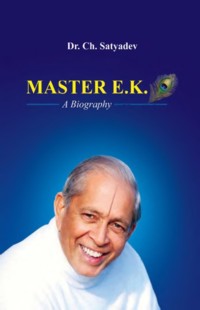
The book "Master E. K. - A Biography" by Dr Ch. Satyadev presents the life, experiences, and teachings of Master E.K.
The Master guided thousands of people through his speech, his gaze, and his touch. He authored voluminous works, undertook numerous journeys abroad, and proclaimed the uniqueness of Indian culture to the wider world. Within the country, he imparted a spiritual vision, method, and discipline of practice. The magnitude of work he accomplished within such a short span of time is truly extraordinary.
The World Teacher Book Trust, Visakhapatnam, India May 2026.
Sample:
In those days of teaching at the University, a departmental reader who was also a colleague of the Master once asked him, “How can you prove that God exists?” The Master said, “Yes— how can you prove it? You cannot!” The discussion went on as follows:Reader: Then why do believers believe in God?
Master: You should ask them.
Reader: Why do you believe?
Master: Why do I believe? I do not believe it.
Reader: Then why have you put on your brow-mark?
Master: There is no link between a brow-mark and God. The brow-mark is mine, not God’s. I wear it for the same reason you wear face powder: I love my brow-marked face when I look in the mirror.
During the same period a great scholar also served at the University, one who had digested many of the Purānas, the Upanisads, the Sastras, and more. One day he asked the Master, “You say everything is God’s WILL, and that man’s WILL too is part of God’s WILL. If we believe this and do nothing, what then? If, believing that all is God’s WILL, I choose not to come to college for three days, what becomes of your idea?” The Master replied at once, “Do not ask me this now. First try to stop coming to college for three days, and ask me on the fourth. Since you will never manage it, you will realize that God’s WILL is everything—you will have proved it by experiment.”
A University student asked the Master, “Every day people come to see you. Wherever you are, at least ten people gather. I suspect you are deliberately drawing them by some magic. What Mantra do you practice?” The Master answered, “There is indeed a great Mantra for drawing people: to work and to serve for their good. Some come for medicines, some to find solutions to the troubles they share with me, others to recite their poems and show their writings. Because I try to be of some use to them, they come. Just as ants gather around a lump of jaggery, people gather around usefulness. The best Mantra for drawing people is never to use them for our own ends.”
A library at Anakapalli invited the Master to give a talk and, as Chief Guest, a University professor. The professor spoke from 6 p.m. until 8:15 p.m. on the topic of “Appropriateness,” touching on the importance of “keeping to time”. Then he said, “Now Krishnamacharya will speak,” and sat down. The Master rose slowly and said, “It is now 8:15 p.m. Considering the state of the audience, I request the Chief Guest to take over my speech as well.” And he sat down. The Chief Guest stood up, stunned; sweating profusely, he came over to Master E.K. and said in a low voice, “Could you at least speak for fifteen minutes?” The Master rose again and said, “We should not imagine that an audience is beneath us. Out of regard for their comfort and for ‘appropriateness’, let us use the opportunity another time.” With that he closed the event, and everyone laughed.
One of the University professors had a habit of suddenly asking his colleagues, “What is the goal of your life?” Most struggled to answer on the spot. One day he put the same question to our Master, who replied at once: “To live is the goal of my life.” At this the professor fell silent for a while. Then, smiling, the Master asked him, “And what is your goal in life?” He had no answer.
To receive Master E.K.’s selfless service, to gather the divine wisdom he radiated, and to take part in his many discourses, people thronged to him in their thousands. Many of the University’s faculty and students regarded him as a divine personality. All this bred unease in certain other professors, who could not bear it—yet the Master always treated them with respect and held no ill opinion of them. When someone told him they were jealous of him, he replied: “Oh, is that so? I did not know. Well, their jealousy is theirs, not mine. What they feel about me is no concern of mine. Only LOVE is my domain; and so, when they ask for help, I give it with the same love.”
In 1972 he made his first journey abroad, to Europe. This too stirred jealousy in some professors. But the Master never said of anyone that he was jealous or hostile; for he was always himself, and the opinions of others never colored his expression of life. He stood always above the opposing pairs of likes and dislikes.
Some of the Master’s colleagues complained to the then Vice Chancellor, Dr. L. Bullayya, that the Master did not attend the University on time and was partial to certain students. Hearing this, the Master merely smiled. Later, in 1974, he ap-plied for leave for a foreign trip, and someone tried very hard to stop the leave from being granted. But the invitations of his foreign disciples kept pressing, in all humility, for his coming. The Master—who by nature kept his daily schedule to the letter, and whose mission as an incarnation was the spiritual fusion of East and West—thought of resigning his post. In 1974, with his natural smile, he resigned from the University for a universal cause.
Some of the faculty and students supposed that he had resigned because of the complaint and the University’s refusal of his leave, and several were troubled by the thought. The Vice Chancellor called the then Registrar, Dr. M. Gopala Krishna Reddy, and said, “Sri Krishnamacharya has resigned without weighing the consequences. He has a large family. He is, moreover, a Brahmin—how will he support them? Ask him to come and see me.” Meanwhile they even had a professor quietly investigate the Master, and the report stated plainly that there was no irregularity in his punctuality and no bias towards particular students. The Registrar asked the Master to meet the Vice Chancellor, and so he did. Opening his heart, the Vice Chancellor said, “In such matters one should not be impulsive; one should decide with care. That is why I have not yet accepted your resignation. Think it over. Please do not act in haste.” The Master replied, with a smile and yet firmly, “I made this decision after careful thought, not on impulse. And the reason is neither the investigation nor the refusal of my leave. God’s WILL is the heart of this decision. I thank you warmly for your love towards me, and the University staff as well.” After some days his resignation was approved. The news shook the University at the time. Yet it is no astonishing thing to leave a University for the sake of carrying out the Divine Plan.
In this connection, one incident deserves mention. On the 12th of June 1972, Elizabeth Warnon (Belgium) asked the Master, “Where you come from, how many people are there whom you hate, or who hate you?” The Master replied gently, “Some may hate me, but I never hate them. Some may wish to be my enemies, but I hold enmity towards no one.”